


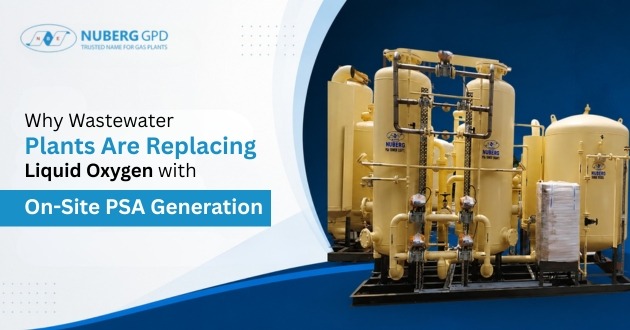
Walk through any wastewater treatment plant and you will find oxygen at the centre of nearly every critical process. Biological treatment, ozonation, and sludge management — all of them depend on a consistent, controlled oxygen supply. For decades, that supply came from liquid oxygen tankers or pressurised cylinders. It worked. But it also meant delivery schedules, price volatility, cryogenic storage risks, and the occasional production interruption when a truck was late. A PSA oxygen generator changes that equation entirely. It produces oxygen on-site, on demand, directly from compressed air — and a growing number of municipal and industrial wastewater plants are making the switch.
This shift is not driven by novelty. It is driven by operating experience, cost pressure, and the realisation that a PSA oxygen gas plant eliminates the most frustrating variables in oxygen supply management. Here is what is happening, why it matters, and what plant engineers and procurement teams need to know.
The Role of Oxygen in Wastewater Treatment
Wastewater treatment is a biological process at its core. Aerobic bacteria break down organic matter, converting BOD and COD into carbon dioxide, water, and biomass. Nitrifying bacteria convert ammonium to nitrate. Both processes depend entirely on dissolved oxygen. When dissolved oxygen drops below 1.5 mg/L in an aeration basin, microbial activity slows. Below 0.5 mg/L, the process can collapse.
Industrial effluents make this more demanding. A food processing plant, a pharmaceutical manufacturer, or a pulp mill discharges wastewater with organic loads far higher than typical municipal sewage. The oxygen demand spikes with production shifts, seasonal variation, and raw material changes. Standard air diffusion systems often cannot keep pace. This is where oxygen enrichment using a PSA oxygen generator becomes not just useful but essential.
Dissolved oxygen is the single most critical parameter in aerobic biological treatment. Maintaining it consistently above 2 mg/L improves BOD removal efficiency, supports stable nitrification, and reduces the risk of sludge bulking — one of the most disruptive operational problems in activated sludge systems.
How a PSA Oxygen Generator Works in a Wastewater Context
Pressure Swing Adsorption separates oxygen from compressed air using zeolite molecular sieve. Nitrogen is selectively adsorbed onto the zeolite under pressure while oxygen passes through and is collected. Two alternating columns ensure continuous output — when one column is adsorbing, the other is regenerating automatically by depressurisation. The result is a steady stream of 93 to 95% oxygen, delivered at controlled pressure to wherever the process needs it.
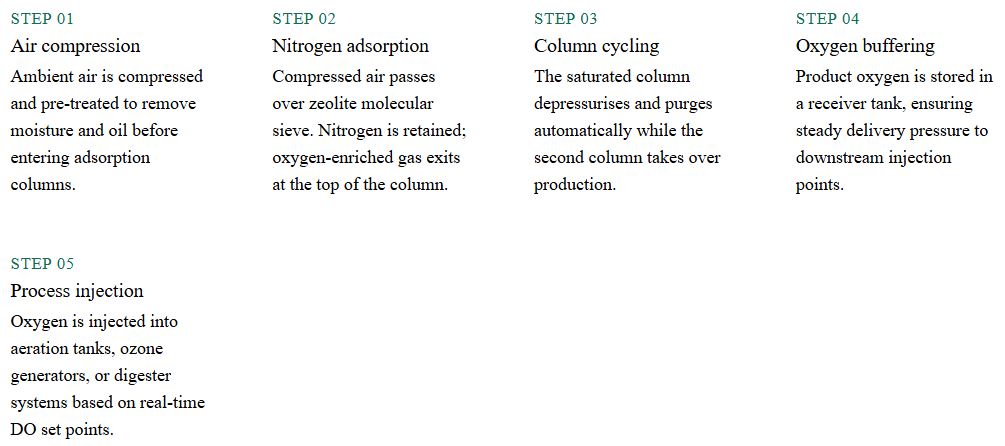
No cryogenic equipment is involved. No specialised storage infrastructure is required. The system starts producing oxygen within minutes of startup and adjusts output automatically to match demand.
Where PSA Oxygen Is Used in Wastewater Treatment
The applications extend well beyond simple aeration. Oxygen touches multiple stages of the treatment process, and each application has its own requirements.
-
Activated sludge aerationHigh-purity oxygen injection raises MLSS concentration and handles higher organic loads in existing tank volumes without civil expansion.
-
Ozonation and tertiary treatmentOzone generators require pure oxygen as feed gas. PSA oxygen makes tertiary ozonation and micropollutant removal economically viable at mid-scale.
- Anaerobic digester micro-aeration
Controlled low-dose oxygen injection into digesters improves biogas quality and reduces hydrogen sulphide concentrations in digester gas. -
Sequencing batch reactorsOxygen-enriched aeration shortens cycle times in SBR systems and improves effluent consistency during variable load conditions.
-
Sludge volume reductionAdequate DO availability prevents sludge bulking, reduces sludge production rates, and lowers downstream dewatering costs over time.
-
Industrial effluent treatment
High BOD loads from food, pharma, and pulp mills require oxygen enrichment that standard air blowers cannot sustain cost-effectively.
PSA Oxygen vs. Liquid Oxygen vs. Air Diffusion.
-
Recommended for most plants
On-site PSA oxygen generatorCost: Low ongoing operating costPurity: 93–95% O₂Supply: Continuous, self-generatedSafety: No cryogenic riskBest for: Medium to large plants, variable or high O₂ demand
-
Liquid oxygen (LOX)Cost: High purchase and logistics costPurity: 99.5%+ O₂Supply: Delivery-dependentSafety: Cryogenic storage on-site
Best for: Small plants or short-term peak demand
-
Air diffusion onlyCost: High blower energy consumptionPurity: 21% O₂ (ambient air)Supply: Continuous but low oxygen intensitySafety: No hazardBest for: Low-load municipal STPs
Technical Specifications That Matter for Wastewater Applications
-
-
Capacity range: 1 to 500 Nm³/hr
-
Oxygen purity: 93% to 95% O₂
-
Outlet pressure: Up to 4 Bar standard.
-
Dew point: Better than –40°C
-
Control system: PLC with DO sensor integration
-
Startup time: Under 2 minutes to operating purity
-
What to Evaluate When Choosing a PSA Oxygen Gas Plant
The technology is proven. The differentiation lies in engineering depth and application knowledge. A reliable oxygen plant manufacturer in India should help you size the system to your actual peak oxygen demand — not a catalogue standard that is either oversized or insufficient.
Demand modulation capability is critical in wastewater. Oxygen requirement changes with influent load, temperature, and time of day. The PSA oxygen gas plant needs a turndown ratio wide enough to follow that variation without cycling inefficiently or wasting product. Look for systems that integrate directly with your dissolved oxygen sensors and SCADA platform so output adjusts automatically.
Zeolite quality determines long-term system performance. Inferior molecular sieve degrades faster, particularly when feed air contains traces of oil or high humidity. A quality oxygen gas manufacturing plant supplier will specify multi-stage air pre-treatment as standard — not optional. Ask for clarity on expected zeolite life, replacement cost, and service support before committing to any system.
The economic case for on-site PSA oxygen in wastewater treatment is straightforward. Liquid oxygen carries production, liquefaction, transport, and supplier margin in every unit price you pay. A PSA oxygen generator converts all of that recurring cost into electricity. At typical consumption levels in a mid-scale treatment plant, full payback is achieved within two to four years — after which oxygen is essentially free.
Evaluating on-site oxygen generation for your wastewater plant?
Nuberg GPD designs and supplies PSA and VPSA oxygen gas plants for municipal and industrial wastewater treatment applications across India and globally. As an established oxygen plant manufacturer in India with over 4,000 installations in 35 countries, our engineering team brings process-specific expertise to every project. We size systems to your actual oxygen demand, integrate with existing SCADA infrastructure, and support the full lifecycle from commissioning to maintenance. Speak with our team to explore the right solution for your facility.