
In industries where precision matters, the source of your hydrogen matters even more. Metallurgical processing, electronics manufacturing, and float glass production – they all demand a consistent, high-purity hydrogen supply. That is where an ammonia cracker earns its place. It is not the newest technology on the shelf, but it remains one of the most practical and cost-effective routes to on-site hydrogen generation available today.
If you are evaluating hydrogen supply options for your plant, this guide breaks down exactly how ammonia cracking works, where it excels, and when a different approach might serve you better.
What Is an Ammonia Cracker and Why Does It Matter?
An ammonia cracker is a thermal decomposition unit. It splits anhydrous ammonia (NH₃) into its constituent gases – 75% hydrogen and 25% nitrogen, using heat and a catalyst. The process is endothermic, meaning it requires an external heat source to sustain the reaction.
The resulting gas mixture is often called “dissociated ammonia” or “forming gas.” It is widely used as a protective or reducing atmosphere in heat treatment operations. Where ultra-pure hydrogen is needed, the output is further purified through a PSA (Pressure Swing Adsorption) unit to achieve purity levels above 99.999%.
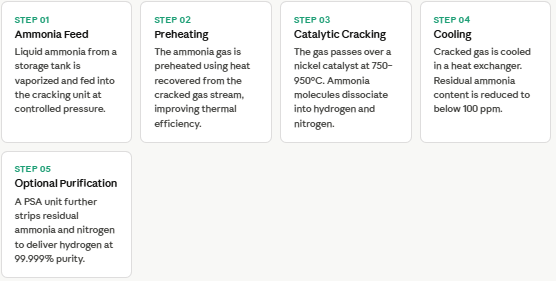
The core reaction: 2NH₃ → 3H₂ + N₂ was carried out at temperatures between 750°C and 950°C over a nickel-based catalyst. Conversion efficiency exceeds 99% in well-designed units.
How an Ammonia Cracker Unit Works: Step by Step
Understanding the internal sequence helps plant engineers size the system correctly and anticipate operational demands. The process follows a logical, well-established path.
The entire sequence is designed for minimal operator intervention. Modern units from a reputable ammonia cracker manufacturer include automated temperature control, safety interlocks, and remote monitoring interfaces.
Key Technical Specifications to Evaluate
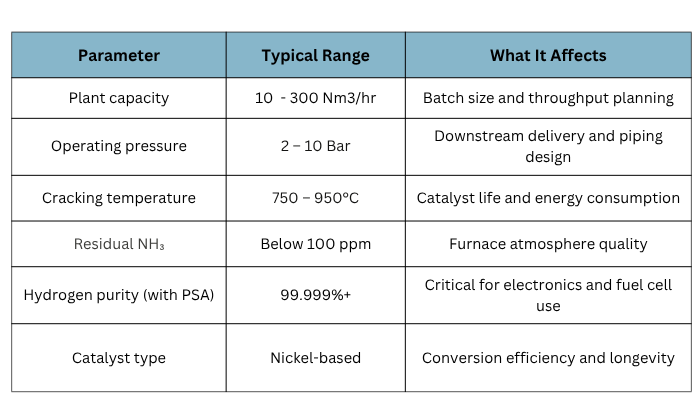
When shortlisting an ammonia cracker for your facility, these are the parameters that matter most from a process engineering standpoint.
When Should You Choose an Ammonia Cracker for Hydrogen Generation?
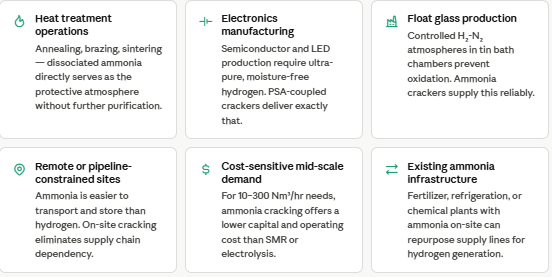
This is the question most procurement and process teams wrestle with. Ammonia cracking is not the right fit for every facility. But for certain operational profiles, it is hard to beat.
Ammonia Cracking vs. Other Hydrogen Generation Methods
No technology wins in every scenario. Here is an honest comparison to help you align the choice with your operating reality.
- Versus Steam Methane Reforming (SMR): SMR is the dominant method globally for large-scale hydrogen generation — above 200 Nm³/hr. It produces very high-purity hydrogen but requires natural gas infrastructure and produces CO₂. For smaller capacities or sites without gas pipelines, ammonia cracking is simpler and cleaner.
- Versus Alkaline Water Electrolysis: Electrolysis produces the purest hydrogen available (up to 99.9997%) and is carbon-free when powered by renewables. However, it carries significantly higher energy costs per Nm³. For green hydrogen targets, electrolysis wins. For industrial atmosphere applications, ammonia cracking wins on economics.
- Versus Methanol Reforming: Methanol reforming suits similar capacity ranges and is preferred where methanol logistics are easier than ammonia. Both are valid; the feedstock availability at your site will often make the decision for you.
Operational Advantages That Make the Difference
Beyond the chemistry, the practical advantages of ammonia cracking deserve attention from the plant operations team.
Ammonia is widely available, easy to store in liquid form under modest pressure, and has an established global supply chain. Unlike hydrogen cylinders, it poses no high-pressure storage risks at the site. A properly designed cracker runs continuously with minimal intervention. Catalyst life typically spans several years with proper feedstock quality. Startup and shutdown sequences are automated in modern units.
For plant managers prioritising uptime and predictable operating costs, these characteristics matter as much as the chemistry itself.
A key consideration often overlooked: ammonia cracking produces no CO₂‚ emissions from the process itself (unlike SMR). The carbon footprint depends on how the ammonia was manufactured – green ammonia from renewable energy makes the entire chain nearly carbon-neutral.
Selecting the Right Ammonia Cracker Manufacturer
The technology is proven. The differentiator is execution. When evaluating suppliers, consider engineering depth – not just whether they supply a unit, but whether they understand your downstream process requirements. A quality ammonia cracker manufacturer should offer capacity sizing support, catalyst selection guidance, integration with your existing gas distribution network, and post-commissioning technical support.
Also evaluate the quality of control systems, safety interlock design, and materials of construction, particularly for components exposed to high-temperature ammonia environments. Certifications, reference installations, and response to technical queries during the sales process all signal how a manufacturer will behave once the unit is commissioned.
Ready to evaluate an ammonia cracker for your facility?
Nuberg GPD’s hydrogen generation systems are engineered for industrial precision. With over 4,000 installations across 35 countries, we bring proven expertise to every project – from capacity sizing and system integration to commissioning and long-term support. Speak with our engineering team to find the right hydrogen generation solution for your specific process needs.