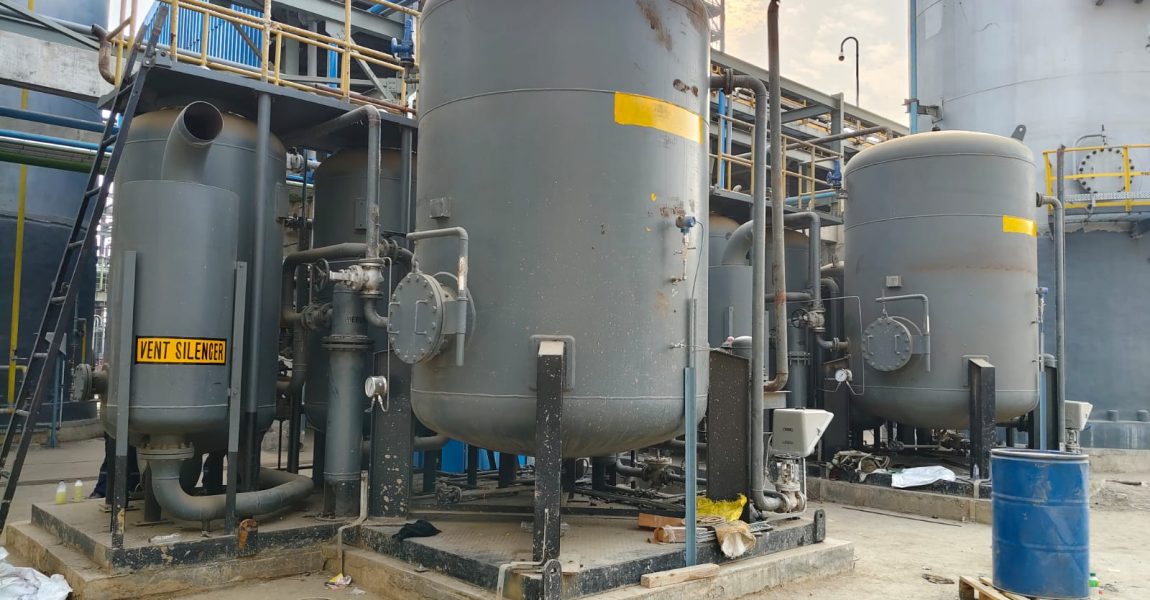
Carbon Molecular Sieve is the core functional material inside a PSA nitrogen generator. The sieve performs the actual gas separation. The compressor, valves, and controls support the process, but CMS determines nitrogen purity, recovery rate, cycle efficiency, and long-term stability.
In industrial nitrogen plants, performance metrics depend directly on CMS quality. These metrics include nitrogen purity level, purity stability over time, nitrogen recovery percentage, energy consumption per Nm³, and adsorbent service life.
Carbon Molecular Sieve is a microporous carbon-based adsorption material used in Pressure Swing Adsorption systems to separate oxygen from nitrogen. CMS contains a controlled pore size distribution. These micropores allow oxygen molecules to diffuse into the structure faster than nitrogen molecules. This process is called selective adsorption.
Oxygen diffuses into the pores quickly due to its smaller kinetic diameter. Nitrogen diffuses more slowly and remains in the gas phase. The system collects nitrogen as the product gas.
CMS has high internal surface area, controlled micropore size, and uniform pore distribution. These properties allow oxygen adsorption while minimizing nitrogen adsorption.
Pressure Swing Adsorption is the separation mechanism used in PSA nitrogen plants. CMS performs separation during controlled pressure cycles through a structured sequence.
Carbon Molecular Sieve is the core functional material inside a PSA nitrogen generator. The sieve performs the actual gas separation. The compressor, valves, and controls support the process, but CMS determines nitrogen purity, recovery rate, cycle efficiency, and long-term stability.
In industrial nitrogen plants, performance metrics depend directly on CMS quality. These metrics include nitrogen purity level, purity stability over time, nitrogen recovery percentage, energy consumption per Nm³, and adsorbent service life.
Carbon Molecular Sieve separates oxygen from nitrogen through selective adsorption. Oxygen molecules diffuse into CMS micropores faster than nitrogen molecules. Nitrogen remains in the gas stream and exits as product gas. The PSA system regenerates CMS by reducing pressure and releasing adsorbed oxygen.
CMS typically lasts between 5 and 10 years. Lifespan depends on air quality, moisture control, pressure stability, and maintenance. Proper pretreatment and stable operating conditions extend service life.
CMS typically lasts between 5 and 10 years. Lifespan depends on air quality, moisture control, pressure stability, and maintenance. Proper pretreatment and stable operating conditions extend service life.
CMS typically lasts between 5 and 10 years. Lifespan depends on air quality, moisture control, pressure stability, and maintenance. Proper pretreatment and stable operating conditions extend service life.
Carbon Molecular Sieve is the core functional material inside a PSA nitrogen generator. The sieve performs the actual gas separation. The compressor, valves, and controls support the process, but CMS determines nitrogen purity, recovery rate, cycle efficiency, and long-term stability.
In industrial nitrogen plants, performance metrics depend directly on CMS quality. These metrics include nitrogen purity level, purity stability over time, nitrogen recovery percentage, energy consumption per Nm³, and adsorbent service life.
Carbon Molecular Sieve is a microporous carbon-based adsorption material used in Pressure Swing Adsorption systems to separate oxygen from nitrogen. CMS contains a controlled pore size distribution. These micropores allow oxygen molecules to diffuse into the structure faster than nitrogen molecules. This process is called selective adsorption.
Oxygen diffuses into the pores quickly due to its smaller kinetic diameter. Nitrogen diffuses more slowly and remains in the gas phase. The system collects nitrogen as the product gas.
CMS has high internal surface area, controlled micropore size, and uniform pore distribution. These properties allow oxygen adsorption while minimizing nitrogen adsorption.
Pressure Swing Adsorption is the separation mechanism used in PSA nitrogen plants. CMS performs separation during controlled pressure cycles through a structured sequence.
Carbon Molecular Sieve is the core functional material inside a PSA nitrogen generator. The sieve performs the actual gas separation. The compressor, valves, and controls support the process, but CMS determines nitrogen purity, recovery rate, cycle efficiency, and long-term stability.
In industrial nitrogen plants, performance metrics depend directly on CMS quality. These metrics include nitrogen purity level, purity stability over time, nitrogen recovery percentage, energy consumption per Nm³, and adsorbent service life.
Carbon Molecular Sieve separates oxygen from nitrogen through selective adsorption. Oxygen molecules diffuse into CMS micropores faster than nitrogen molecules. Nitrogen remains in the gas stream and exits as product gas. The PSA system regenerates CMS by reducing pressure and releasing adsorbed oxygen.
CMS typically lasts between 5 and 10 years. Lifespan depends on air quality, moisture control, pressure stability, and maintenance. Proper pretreatment and stable operating conditions extend service life.
CMS typically lasts between 5 and 10 years. Lifespan depends on air quality, moisture control, pressure stability, and maintenance. Proper pretreatment and stable operating conditions extend service life.
CMS typically lasts between 5 and 10 years. Lifespan depends on air quality, moisture control, pressure stability, and maintenance. Proper pretreatment and stable operating conditions extend service life.
Home / Pressure swing adsorption nitrogen generation: how it works and why it matters Pressure swing adsorption nitrogen generation is the standard way to make nitrogen on-site from compressed air. Most factories that use nitrogen every day now make it this
Home / What is a hydrogen cracker? Working principle, uses, and benefits A hydrogen cracker is a unit that splits ammonia into a hydrogen-rich gas, right at the factory that needs it. Bright annealing lines and brazing furnaces use this gas
Home / Industrial chemical processes use catalysts as silent motors that initiate and accelerate desired physicochemical reactions. In particular, a nickel catalyst is considered one of the most versatile and cost-effective solutions for gas processing in large-scale production facilities. It is
Please fill in your details to download our brochure.