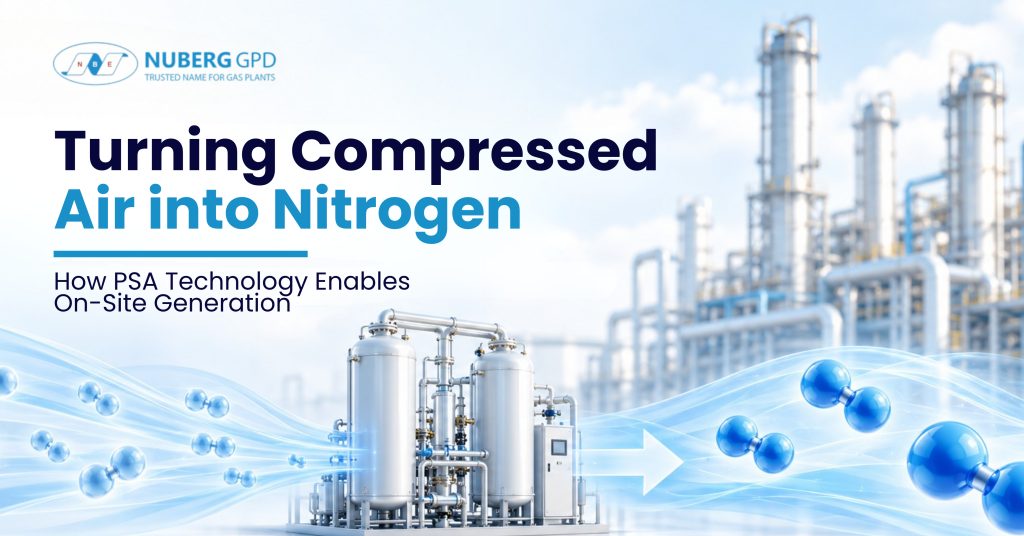
Pressure swing adsorption nitrogen generation is the standard way to make nitrogen on-site from compressed air. Most factories that use nitrogen every day now make it this way instead of buying it in.
Air is already 78% nitrogen. A PSA system just takes the oxygen out.
Plants that still run on cylinders or liquid nitrogen know the problem well. A cylinder bank runs empty mid-shift, or a tanker arrives a day late, and the line stops.
This guide explains how PSA works step by step, and where it beats cylinder supply.
PSA stands for pressure swing adsorption. It separates gases using a material that holds some molecules and lets others pass.
That material is carbon molecular sieve, or CMS. It looks like small black pellets full of tiny pores. An oxygen molecule is about 3.46 ångström across, while a nitrogen molecule is about 3.64. The gap is small. But it is enough for oxygen to slip into the pores and get stuck, while nitrogen flows past.
The “swing” is the pressure change. At high pressure the sieve holds oxygen, and when the pressure drops it lets the oxygen go.
A PSA nitrogen generator runs two towers in turns, so one always makes nitrogen while the other cleans itself. Here is the nitrogen generator process, step by step.
Step 1: Air compression
A compressor pulls in air and raises it to roughly 4 to 13 bar, the inlet range most PSA units accept.
Step 2: Air treatment
Filters and a dryer remove oil, dust and moisture before the air reaches the sieve. Skip this and the sieve degrades. Water and oil are the two things that shorten CMS life the most, which is why a correctly sized industrial air dryer system is part of every PSA installation we build.
Step 3: Adsorption in tower A
Clean air enters the first CMS tower. Oxygen, carbon dioxide and traces of moisture stick to the sieve. Nitrogen leaves the top at high purity.
Step 4: Pressure equalisation
When tower A is close to full, the two towers connect briefly and share pressure. This saves compressed air and energy.
Step 5: Regeneration in tower B
Tower B vents down to low pressure. The trapped oxygen escapes through the exhaust, pushed out by a small purge flow of nitrogen.
Step 6: Switching
The towers swap. Tower B makes nitrogen and tower A regenerates. The cycle repeats every minute or so, and a buffer tank after the generator smooths out pressure changes.
How purity is controlled
Cycle timing sets purity. Shorter cycles give higher purity and less flow, while longer cycles give more flow at lower purity.
A PSA nitrogen generator can cover roughly 95% to 99.999% purity. Atlas Copco puts typical needs at 90 to 99% for tyre inflation and fire prevention, and 97 to 99.999% for food, beverage and plastic moulding. For the science behind the sieve, see our article on the adsorption process in industrial gas separation.
Any industry that needs an inert, oxygen-free gas can use PSA nitrogen. The main users are:
We supply nitrogen systems to both the pharmaceutical industry and the chemical industry, where purity and uptime are tightly controlled.
The biggest change is that nitrogen becomes a utility, like compressed air, instead of a delivery you wait for.
On-site supply
You make nitrogen where you use it. As long as the compressor runs, nitrogen flows, 24 hours a day.
Purity you set
You set the purity your process needs. If 98% does the job, you do not pay to make 99.999%.
Low maintenance
Routine work is mostly inlet filter changes and checks on the pressure, temperature and dew point sensors. A well-kept carbon molecular sieve lasts 10 years or more.
Lower running cost
Electricity for the air compressor is the main running cost. You also drop cylinder rental, transport and handling fees. Atlas Copco puts typical payback against cylinder or liquid supply at 6 months to 3 years, depending on how much nitrogen you use.
| Comparison | FEED | Detailed Engineering |
|---|---|---|
| Main Question | Should we build it, and at what cost? | How exactly do we build it? |
| Output | Process diagrams, equipment list, budget estimate | Construction drawings, specifications, material lists |
| Used By | Project owners and investors | Engineering, procurement, and construction teams |
When nitrogen runs out, production stops.
A packaging line cannot seal packs, and a reactor cannot be purged before start-up. Pressure swing adsorption nitrogen generation puts that supply under the plant’s own control. It also takes cylinder handling and truck movements off site, which makes the plant safer.
The technology works at large scale too. We built a 1,080 Nm³/hr PSA nitrogen plant for UHDE India in Nashik, with one of the tallest PSA nitrogen towers in the world.
PSA turns compressed air into a steady nitrogen supply at the purity you choose. Compress, clean, adsorb, regenerate, repeat.
Backed by over 30 years of experience, Nuberg GPD designs and builds PSA nitrogen gas plants for food, pharma, chemical and metal plants, with capacities from 5 to 1,100 Nm³/hr. The range runs from the MX Model nitrogen generator to the MS-H, CU-DX and DX models. Every system comes with fully automatic PLC controls for seamless operation. Each one is engineered for maximum energy efficiency and backed by our comprehensive worldwide service network. For RCF Mumbai, we commissioned a 500 Nm³/hr plant at 99.999% purity.
Share your flow and purity needs with our team and we will size the system for you.
PSA, or pressure swing adsorption, separates nitrogen from compressed air. A carbon molecular sieve traps oxygen under pressure and releases it when the pressure drops.
A PSA nitrogen generator is a system with two towers filled with carbon molecular sieve. It takes in clean, dry compressed air and delivers nitrogen on-site, usually at 95% to 99.999% purity.
It works by cycling pressure. At high pressure the sieve adsorbs oxygen and lets nitrogen pass. At low pressure it releases the oxygen, so the sieve is ready for the next cycle.
The PSA method compresses and dries air, then passes it through two sieve towers that take turns. One tower makes nitrogen while the other regenerates, and they switch about every minute to keep the supply continuous.
Home / Pressure swing adsorption nitrogen generation: how it works and why it matters Pressure swing adsorption nitrogen generation is the standard way to make nitrogen on-site from compressed air. Most factories that use nitrogen every day now make it this
Home / What is a hydrogen cracker? Working principle, uses, and benefits A hydrogen cracker is a unit that splits ammonia into a hydrogen-rich gas, right at the factory that needs it. Bright annealing lines and brazing furnaces use this gas
Home / Industrial chemical processes use catalysts as silent motors that initiate and accelerate desired physicochemical reactions. In particular, a nickel catalyst is considered one of the most versatile and cost-effective solutions for gas processing in large-scale production facilities. It is
Please fill in your details to download our brochure.