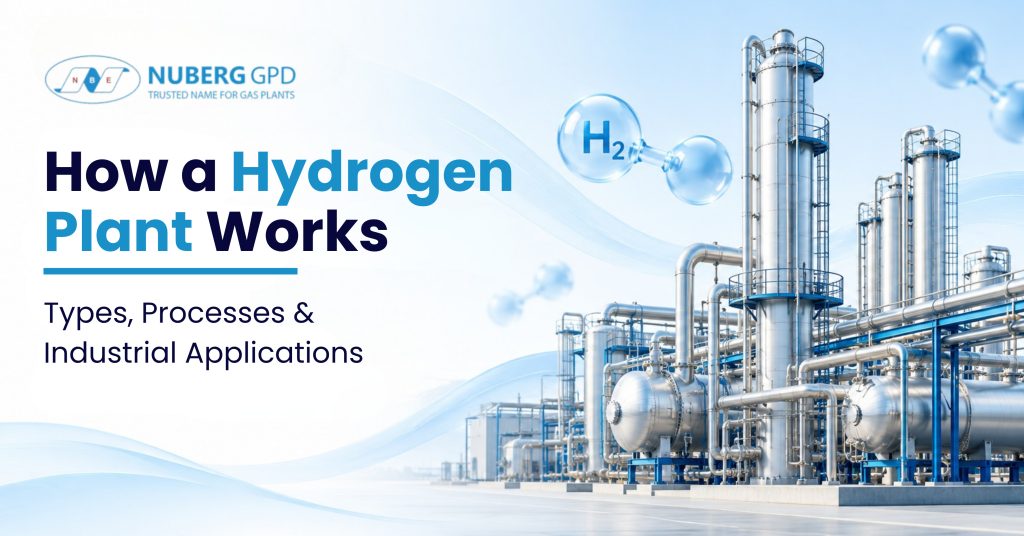
It is an industrial unit that makes hydrogen gas on-site from a feedstock such as water, natural gas, methanol or ammonia. Refineries use this hydrogen to remove sulphur from fuels. Float glass lines need it above the tin bath, and metal plants rely on it to keep annealed steel bright.
This guide explains how a hydrogen generation plant works and covers the four main plant types. It also shows where each type fits and how to pick the right one for your process.
A hydrogen plant takes a raw material that contains hydrogen and releases that hydrogen through a chemical or electrical process. The feedstock is the first big decision. It decides your running cost, the purity you can reach and how far the plant can scale.
Water needs only electricity. Natural gas gives the lowest cost per cubic metre at large volumes. Methanol and ammonia arrive as liquids, so they suit sites with no gas pipeline.
Most plants share the same core parts: a feed system, a reactor or electrolyser stack, a purification unit, a dryer and a PLC control panel.
The hydrogen plant working principle follows four stages, regardless of the feedstock.
Purification sets the final quality. Two plants with the same reactor can deliver 99.5% or 99.999% hydrogen, depending on the purifier fitted after it.
Industry relies on four main types of hydrogen plants. Each starts from a different feedstock, and that single choice shapes most of the plant design. For a wider look at global production routes, see this overview of hydrogen production methods.
An alkaline electrolyser passes DC current through water mixed with potassium hydroxide. Hydrogen forms at the cathode and oxygen at the anode. With a deoxo purifier and dryer, purity reaches 99.999%. Electricity is the main running cost, at roughly 4.5 to 5 kWh per Nm³ of hydrogen. Powered by solar or wind, the output counts as green hydrogen.
Natural gas reacts with steam over a nickel catalyst at about 800 to 900 °C. A shift reactor turns the carbon monoxide into extra hydrogen, and PSA cleans up what remains. It is the most widely used route in the world and the cheapest at high volumes.
Methanol and water vapour react over a copper-based catalyst at around 250 to 300 °C. The low temperature means quick start-up, and the feed arrives by tanker. This makes it a practical option for medium demand where no gas pipeline reaches the site.
An ammonia cracker splits ammonia into 75% hydrogen and 25% nitrogen over a heated nickel catalyst. This mix suits bright annealing, brazing and sintering. Our guide on how a hydrogen cracker works covers the process step by step.
Hydrogen plant applications reach into most process industries. The common ones include:
| Plant type | Feedstock | Typical purity | Best fit |
|---|---|---|---|
| Alkaline water electrolysis | Water + electricity | Up to 99.999% | Green hydrogen, high-purity needs |
| Steam methane reforming | Natural gas + steam | Up to 99.999% with PSA | Large, continuous demand |
| Methanol reforming | Methanol + water | Up to 99.999% with PSA | Medium demand, no gas pipeline |
| Ammonia cracking | Ammonia | 75% H₂ + 25% N₂ | Furnace atmospheres |
Backed by over 30 years of experience, Nuberg GPD delivers high-performance hydrogen plants, from alkaline water electrolysis and steam methane reforming to methanol reforming units and ammonia crackers. Our systems are equipped with fully automatic PLC controls for seamless operation, engineered for maximum energy efficiency, and supported by our comprehensive worldwide service network.
Share your hydrogen flow and purity needs with our team and we will recommend the right plant. Explore our hydrogen gas plants or contact us today.
It supplies hydrogen on-site for refining, float glass, edible oil hydrogenation, heat treatment and chemical processes, so the user no longer depends on cylinder deliveries.
Alkaline water electrolysis with a deoxo purifier and dryer reaches 99.999%. Reforming plants can match this when fitted with a PSA unit.
Yes. A purification and recovery system uses PSA or membranes to pull hydrogen out of refinery purge gas and other off-gas streams for reuse.
Home / It is an industrial unit that makes hydrogen gas on-site from a feedstock such as water, natural gas, methanol or ammonia. Refineries use this hydrogen to remove sulphur from fuels. Float glass lines need it above the tin bath,
Home / Pressure swing adsorption nitrogen generation: how it works and why it matters Pressure swing adsorption nitrogen generation is the standard way to make nitrogen on-site from compressed air. Most factories that use nitrogen every day now make it this
Home / What is a hydrogen cracker? Working principle, uses, and benefits A hydrogen cracker is a unit that splits ammonia into a hydrogen-rich gas, right at the factory that needs it. Bright annealing lines and brazing furnaces use this gas
Please fill in your details to download our brochure.