
How Oxygen Is Produced in an Industrial Oxygen Generation Plant System
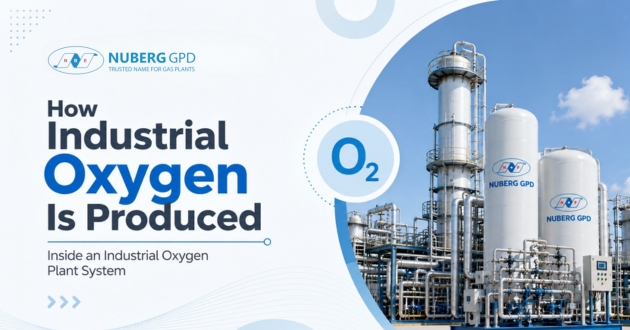
How Oxygen Is Produced in an Industrial Oxygen Generation Plant System
Industrial facilities need a steady oxygen supply for many critical processes. An oxygen generation plant produces oxygen directly from atmospheric air, which is roughly 21% oxygen and 78% nitrogen. Industries can generate oxygen at their own site instead of relying on external cylinder supply.
Modern industrial oxygen plant systems commonly use Pressure Swing Adsorption (PSA) and Vacuum Pressure Swing Adsorption (VPSA). Both technologies separate nitrogen from air through selective adsorption, but they differ in operating pressure and regeneration method.
What Is an Industrial Oxygen Plant System?
An industrial oxygen plant separates oxygen from atmospheric air. It prepares compressed or low-pressure air, removes contaminants, and passes the air through an adsorbent bed.
The adsorbent captures nitrogen. What’s left is an oxygen-enriched product stream ready for industrial use.
Nuberg GPD offers industrial oxygen plant systems based on PSA and VPSA technologies, engineered around oxygen demand, purity and capacity.
Main Components of an Oxygen Plant
A typical industrial oxygen generation system includes:
- Air compressor or blower: supplies feed air to the process.
- Air filtration and drying unit: removes moisture, oil, dust and other contaminants.
- Adsorption vessels: hold the adsorbent and alternate between adsorption and regeneration.
- Zeolite molecular sieve: selectively adsorbs nitrogen from prepared air.
- Oxygen receiver: stores and stabilizes the oxygen-enriched product stream.
- Control and monitoring system: manages valves, pressure, cycle timing and operating conditions.
Feed-air quality has a direct effect on adsorbent life. Industrial air dryer systems play an important role here, since moisture and contaminants that reach the molecular sieve reduce its performance over time.
How an Oxygen Generation Plant Produces Oxygen
The oxygen production process happens in repeating stages.
Atmospheric air enters the system first. In a PSA plant, a compressor raises the air pressure, then the air passes through filtration and drying equipment.
Clean air then enters an adsorption vessel filled with zeolite molecular sieve. At the selected pressure, the zeolite preferentially adsorbs nitrogen while oxygen passes through the bed toward the product receiver. This separation relies on the definition of adsorption, where molecules accumulate at the surface of an adsorbent.
Before the adsorbent saturates, the system switches airflow to a second vessel. The first vessel then regenerates: its pressure drops, and the adsorbed nitrogen releases from the molecular sieve.
This adsorption-regeneration cycle repeats automatically, which is what lets the plant deliver a continuous oxygen supply.
PSA and VPSA Oxygen Production
PSA Oxygen System
A PSA oxygen generation plant uses compressed air and pressure cycling. During adsorption, the molecular sieve captures nitrogen at higher pressure while oxygen continues through the vessel as product. During regeneration, pressure drops toward atmospheric conditions and the nitrogen releases.
PSA systems typically serve small and medium oxygen requirements.
VPSA Oxygen System
A VPSA oxygen generation system uses the same selective-adsorption principle, but at lower feed pressure with vacuum-assisted regeneration. A vacuum pump lowers vessel pressure below atmospheric during regeneration, preparing the bed for the next cycle.
VPSA generally suits larger, more continuous oxygen requirements. Engineers evaluating a plant should weigh the PSA and VPSA oxygen plant differences against capacity, pressure and energy needs. Research on Pressure Swing Adsorption for oxygen production points to adsorption conditions and process design as the factors that matter most here.
Factors Affecting Oxygen Plant Performance
A few variables shape how well an oxygen generation plant performs. Required purity and production capacity set the baseline design. Feed-air quality and operating pressure affect how consistently the plant hits that target, and the condition of the molecular sieve determines how long it can keep doing so. Energy consumption ties all of these together, since tighter purity or higher capacity generally costs more power.
Contaminated feed air degrades the adsorbent over time. Unsuitable pressure or cycle timing can also reduce oxygen recovery. Plant design has to balance purity, capacity and energy use against each other, not optimize any one in isolation
Industrial Applications
On-site oxygen generation supports processes across several industries, including:
- Steel and metal processing
- Glass manufacturing
- Pulp and paper
- Wastewater treatment
- Chemical and petrochemical industries
Each application has its own oxygen flow and purity requirements, so the plant should be sized to match actual process demand rather than a generic capacity figure.
Benefits of On-Site Oxygen Generation
On-site oxygen generation gives a facility more control over its own supply and cuts dependence on outside deliveries. It also reduces cylinder handling and transportation.
Producing oxygen at the point of use makes supply more predictable, and a properly designed system can adjust as oxygen demand changes. That gives the facility a level of control over production planning that cylinder-based supply can’t match.
Conclusion
An industrial oxygen plant produces oxygen through air preparation, nitrogen adsorption, oxygen collection and adsorbent regeneration. PSA and VPSA rely on the same separation principle, but their operating methods differ in pressure and regeneration approach.
Choosing the right oxygen generation plant comes down to purity, capacity, feed-air quality, energy use and operating conditions. Get the design right, and on-site oxygen generation becomes a dependable, long-term supply for the facility.
FAQ
It prepares atmospheric air, removes contaminants, and passes the air through zeolite molecular sieve. The sieve adsorbs nitrogen, while oxygen continues as the product gas.
Zeolite molecular sieve is commonly used because it selectively adsorbs nitrogen from atmospheric air.
PSA uses compressed air and pressure reduction for regeneration. VPSA uses lower-pressure feed air and vacuum-assisted regeneration.
Steel, glass, pulp and paper, wastewater treatment, and chemical and petrochemical industries commonly use on-site oxygen systems.
Recent Posts
Categories
- PSA Oxygen
- PSA Nitrogen
- Uncategorized
- VPSA Oxygen
Product
- Hydrogen Plants
- Oxygen Plants
- Air Dryer Systems
- Nitrogen Gas Plants
- Solvent Dehydation System
Recent Posts
Pressure swing adsorption nitrogen generation: how it works and why it matters
Home / Pressure swing adsorption nitrogen generation: how it works and why it matters Pressure swing adsorption nitrogen generation is the standard way to make nitrogen on-site from compressed air. Most factories that use nitrogen every day now make it this
What is a hydrogen cracker? Working principle, uses, and benefits
Home / What is a hydrogen cracker? Working principle, uses, and benefits A hydrogen cracker is a unit that splits ammonia into a hydrogen-rich gas, right at the factory that needs it. Bright annealing lines and brazing furnaces use this gas
What is Nickel Catalyst and Its Role in Industrial Gas Processes
Home / Industrial chemical processes use catalysts as silent motors that initiate and accelerate desired physicochemical reactions. In particular, a nickel catalyst is considered one of the most versatile and cost-effective solutions for gas processing in large-scale production facilities. It is
