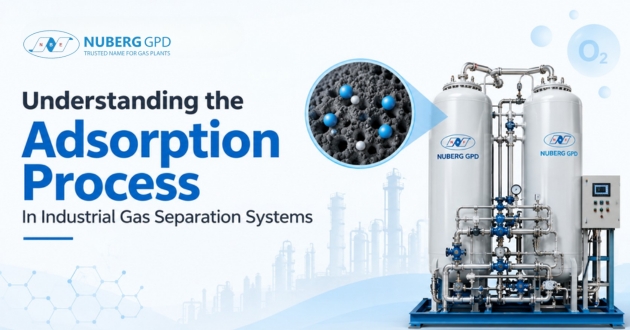
Industrial gases often need separation, purification or drying before use. The adsorption process handles this because selected molecules attach to porous solid surfaces.
In industrial gas separation, adsorption separates oxygen and nitrogen, removes moisture and purifies gas streams. That’s why it plays a central role in so many gas generation and purification systems.
Adsorption is a surface phenomenon: molecules from a gas or liquid collect on an adsorbent surface. Porous adsorbents provide a large internal surface area, so they can retain selected molecules while letting others pass through.
This selective behavior is what makes adsorption useful across industrial gas systems. IUPAC’s definition of adsorption centers on the same idea, describing adsorption as enrichment of a component at an interface.
Adsorption and absorption are different processes, even though the terms sound similar.
Parameter | Adsorption | Absorption |
Where it occurs | At the surface | Within the bulk of a material |
Mechanism | Molecules attach to a surface | Molecules enter another phase |
Common use | Gas separation and drying | Gas scrubbing and solvent removal |
Typical medium | Molecular sieve, CMS, activated carbon | Liquid solvent or absorbent |
Adsorption performance depends on surface area, pore structure and selectivity.
The gas separation process works because different molecules interact differently with a porous adsorbent. Several factors influence this behavior:
These principles form the basis of the Pressure Swing Adsorption process used in many gas generation and purification systems.
Pressure cycling allows one adsorbent bed to separate selected gas molecules while another regenerates. This repeating cycle supports a stable product-gas supply.
Zeolite Molecular Sieve is a crystalline, microporous adsorbent. It’s widely used for selective nitrogen adsorption and moisture removal.
In oxygen generation, molecular sieve adsorption retains nitrogen, leaving an oxygen-enriched product stream to pass through the system.
Carbon Molecular Sieve, or CMS, is widely used in PSA nitrogen generation.
Its controlled microporous structure lets oxygen diffuse into the adsorbent faster than nitrogen, so nitrogen stays mainly in the product stream.
Activated carbon has a highly developed porous structure. It removes selected impurities and hydrocarbons from industrial gas streams.
A typical adsorption cycle runs through five main stages.
The desorption stage releases molecules that were retained during adsorption. Alternating vessels allow product gas delivery to continue while another bed regenerates, so the gas separation system maintains a stable supply.
The same adsorption principle can produce different gases depending on the adsorbent used.
Application | Adsorbent | Gas Adsorbed | Product Gas | Technology |
Oxygen generation | Zeolite Molecular Sieve | Nitrogen | Oxygen-enriched gas | PSA/VPSA |
Nitrogen generation | Carbon Molecular Sieve | Oxygen | Nitrogen | PSA |
In a VPSA oxygen plant, low-pressure adsorption works with vacuum-assisted regeneration.
In nitrogen generation, CMS selectively adsorbs oxygen, and nitrogen passes through the vessel as the desired product gas.
Several operating conditions affect adsorption performance: pressure, temperature, feed-gas quality, cycle time and adsorbent condition.
Moisture, oil and particulates can contaminate adsorbent pores, and incorrect pressure or cycle timing can reduce gas quality. Stable feed preparation and controlled operating conditions are what keep separation efficient.
The adsorption process is widely used for:
Molecular sieve adsorption, for example, can remove moisture from gas and solvent streams.
However it’s applied, engineers have to match the adsorbent to the target component, process conditions and required product quality.
The adsorption process is fundamental to modern industrial gas separation. It separates molecules according to surface attraction, pore structure and operating conditions.
Zeolite Molecular Sieve, Carbon Molecular Sieve and activated carbon perform different separation duties. Reliable operation also depends on pressure, temperature, feed quality, cycle time and regeneration.
Nuberg GPD applies adsorption-based technologies across oxygen, nitrogen, drying and purification systems to support dependable industrial gas separation.
Adsorption is the accumulation of selected gas molecules on the surface of a porous adsorbent. This allows components of a gas mixture to be separated.
Adsorption occurs on a material surface. Absorption occurs when a substance enters and becomes distributed within another material.
Zeolite Molecular Sieve is commonly used because it selectively adsorbs nitrogen from air.
Carbon Molecular Sieve is commonly used in PSA nitrogen systems because it preferentially adsorbs oxygen.
Home / Industrial chemical processes use catalysts as silent motors that initiate and accelerate desired physicochemical reactions. In particular, a nickel catalyst is considered one of the most versatile and cost-effective solutions for gas processing in large-scale production facilities. It is
Home / Nitrogen gas plays a critical role in modern industrial manufacturing and is widely used for inerting, purging, blanketing, and preventing oxidation. Historically, facilities sourced cylinders of high-pressure nitrogen gas delivered on-site. However, with rising cylinder rental costs, gas boil-off
Home / Industrial gases often need separation, purification or drying before use. The adsorption process handles this because selected molecules attach to porous solid surfaces. In industrial gas separation, adsorption separates oxygen and nitrogen, removes moisture and purifies gas streams. That’s