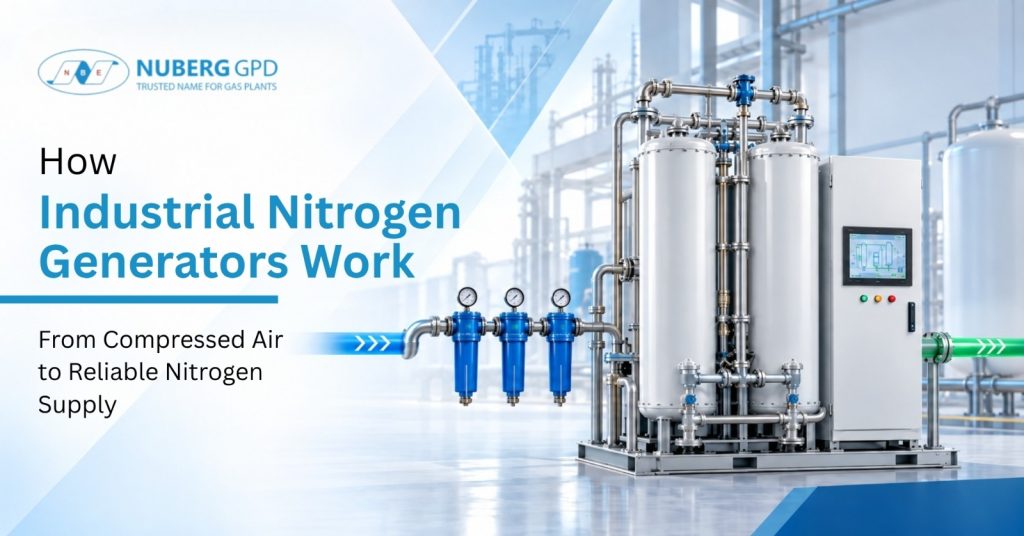
Nitrogen gas plays a critical role in modern industrial manufacturing and is widely used for inerting, purging, blanketing, and preventing oxidation. Historically, facilities sourced cylinders of high-pressure nitrogen gas delivered on-site. However, with rising cylinder rental costs, gas boil-off losses, and the hazards of storing high-pressure containers, more facilities are turning to an industrial nitrogen generator as a safer, on-site alternative.
An industrial nitrogen generator is an onsite system that produces high purity nitrogen gas from ambient compressed air. Air contains roughly 78% nitrogen, 21% oxygen, and trace amounts of other atmospheric gases. Using innovative physical separation techniques, the system extracts nitrogen at the purity level required by the application.
The working principle of a nitrogen generator is typically based on either pressure swing adsorption (PSA) or membrane separation — both methods used to separate nitrogen from the mix of gases in ambient air.
Ambient Air → Air Compressor → Air Treatment → PSA Module (CMS) → Pure Nitrogen Gas
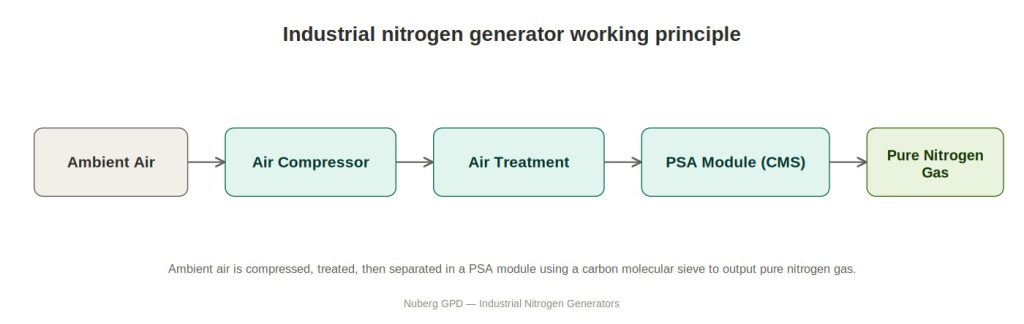
Within a PSA nitrogen generator, ambient air is first compressed by the air compressor before being fed into the air treatment system, where particulates, hydrocarbons, and moisture are removed.
The treated air then moves into the heart of the nitrogen generation system: the PSA module. There, two towers connected in series — each containing a carbon molecular sieve (CMS) — take turns adsorbing nitrogen while allowing oxygen and water vapor to pass through, with a blower attached at the top and bottom of the system.
Once a CMS tower becomes saturated with oxygen, the valve on the opposing chamber opens, releasing moisture and recharging the tower with fresh air so it’s ready to begin another cycle.
An on-site nitrogen generation system requires several components working together to produce industrial-grade nitrogen gas for your facility:
Facilities across industries rely on on-site nitrogen generation technology to meet a range of manufacturing needs:
A key benefit of a high purity nitrogen generator is the substantial cost reduction compared to traditional cylinder purchase or rental. These dedicated systems also ensure a constant nitrogen supply matched to a facility’s exact flow-rate needs, eliminating delivery-logistics challenges and reducing waste.
On-site systems are also significantly safer than traditional high-pressure gas cylinders, since they avoid many of the OSHA-related concerns tied to storing and distributing pressurized containers. In addition, a nitrogen generation system can be tuned to the exact purity level an application requires — while typical industrial applications need only 95% pure nitrogen, more sensitive uses such as chemical processing or semiconductor manufacturing require up to 99.999% purity to avoid costly contamination.
Switching to an industrial nitrogen generator gives facilities the flexibility to produce the exact grade of nitrogen they need, along with a consistent, ongoing supply. When evaluating industrial nitrogen generators, facilities should consider flow characteristics, minimum purity requirements, and peak flow demand to select the right system size for their operations.
An onsite system that produces high purity nitrogen gas from ambient compressed air, using physical separation techniques to extract nitrogen at the purity level an application needs.
It works on either pressure swing adsorption (PSA) or membrane separation. In a PSA system, compressed air passes through a carbon molecular sieve that adsorbs nitrogen while letting oxygen and moisture pass through.
It depends on the application typical industrial uses need around 95% purity, while sensitive processes like chemical processing or semiconductor manufacturing require up to 99.999% purity.
It cuts the cost of cylinder purchases or rentals, ensures a constant nitrogen supply matched to your flow-rate needs, and is safer than storing and handling high-pressure gas cylinders.
Home / Industrial chemical processes use catalysts as silent motors that initiate and accelerate desired physicochemical reactions. In particular, a nickel catalyst is considered one of the most versatile and cost-effective solutions for gas processing in large-scale production facilities. It is
Home / Nitrogen gas plays a critical role in modern industrial manufacturing and is widely used for inerting, purging, blanketing, and preventing oxidation. Historically, facilities sourced cylinders of high-pressure nitrogen gas delivered on-site. However, with rising cylinder rental costs, gas boil-off
Home / Industrial gases often need separation, purification or drying before use. The adsorption process handles this because selected molecules attach to porous solid surfaces. In industrial gas separation, adsorption separates oxygen and nitrogen, removes moisture and purifies gas streams. That’s