
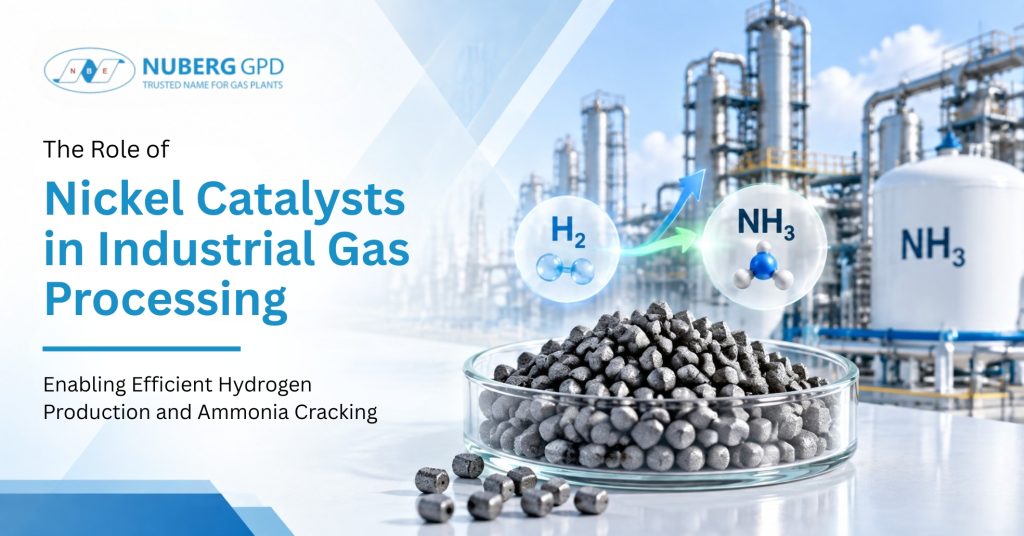
Industrial chemical processes use catalysts as silent motors that initiate and accelerate desired physicochemical reactions. In particular, a nickel catalyst is considered one of the most versatile and cost-effective solutions for gas processing in large-scale production facilities. It is primarily used in low-cost steam reforming, thermal cracking, and other processes to produce clean hydrogen and gas.
A nickel catalyst is a type of heterogeneous chemical catalyst that consists of active nickel metal and an inorganic porous support. Common support materials include alumina (Al2O3), silica, and calcium aluminate.
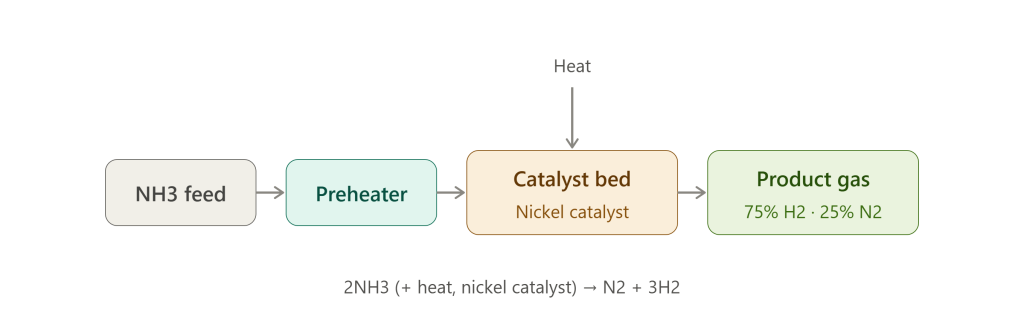
Compressed feed gas – preheated catalyst bed – catalysed reaction – product gas
Since pure nickel tends to oxidize at high temperatures, a nickel catalyst usually contains a mixture of nickel and the supporting material. The latter provides stability, temperature resistance, and high surface area for the nickel to adhere to, thus, increasing the surface area exposed to the incoming gas.
The main property of a nickel catalyst is its ability to reduce the energy required to start a reaction, that is, to lower the activation energy of a chemical reaction. When a gas mixture is passed through the catalyst bed, its molecules interact with the active sites on the surface of the catalyst. As a result, interactions weaken the bonds of the reacting molecules. For example, nickel catalysts facilitate the cleavage of strongly bonded C-H and N-H groups in methane or ammonia molecules, allowing the reaction to proceed at a much lower temperature.
Nickel catalysts are used in industrial gas processing in hydrogen production and ammonia cracking:
1. Steam-methane reforming process
A nickel catalyst is a key element in the reformer, where it catalyzes the reaction of natural gas with high-temperature steam to produce syngas. Subsequently, syngas undergoes further processing to produce clean hydrogen gas.
2. Ammonia cracking process
Nickel catalysts are used to decompose anhydrous ammonia (NH3) into nitrogen and hydrogen:

2NH₃ → N₂ + 3H₂
Catalyst: Nickel catalyst · Conditions: Heat (endothermic reaction)
This endothermic reaction is used in ammonia crackers to obtain a gas mixture of 75% hydrogen and 25% nitrogen. Such a method allows for obtaining high-purity hydrogen without the need to store gas cylinders with flammable content.
Nickel catalysts are used to accelerate gas-phase reactions in various industrial processes, including:
To ensure the maximum efficiency of an industrial nickel catalyst, it is necessary to maintain optimal process conditions, namely:
When operating or maintaining an ammonia cracker or hydrogen generator, one has to choose the optimal catalyst for the given process conditions. A nickel catalyst is an excellent choice for low-cost processes because it allows for reducing the reaction temperature and increasing the reaction rate.
A heterogeneous chemical catalyst made of active nickel metal on an inorganic porous support (alumina, silica, or calcium aluminate) that lowers the activation energy of gas-phase reactions.
It’s mainly used in steam-methane reforming and ammonia cracking to produce clean hydrogen gas, as well as in methanation and edible oil hydrogenation processes.
It weakens the C-H and N-H bonds in methane or ammonia molecules, letting the reaction proceed at a much lower temperature than it otherwise would.
Excessive temperature, impurities like hydrogen sulfide and chlorine, carbon deposition (coking), and rapid thermal or mechanical stress all reduce catalyst activity or damage its structure.

Home / Industrial chemical processes use catalysts as silent motors that initiate and accelerate desired physicochemical reactions. In particular, a nickel catalyst is considered one of the most versatile and cost-effective solutions for gas processing in large-scale production facilities. It is
Home / Nitrogen gas plays a critical role in modern industrial manufacturing and is widely used for inerting, purging, blanketing, and preventing oxidation. Historically, facilities sourced cylinders of high-pressure nitrogen gas delivered on-site. However, with rising cylinder rental costs, gas boil-off
Home / Industrial gases often need separation, purification or drying before use. The adsorption process handles this because selected molecules attach to porous solid surfaces. In industrial gas separation, adsorption separates oxygen and nitrogen, removes moisture and purifies gas streams. That’s