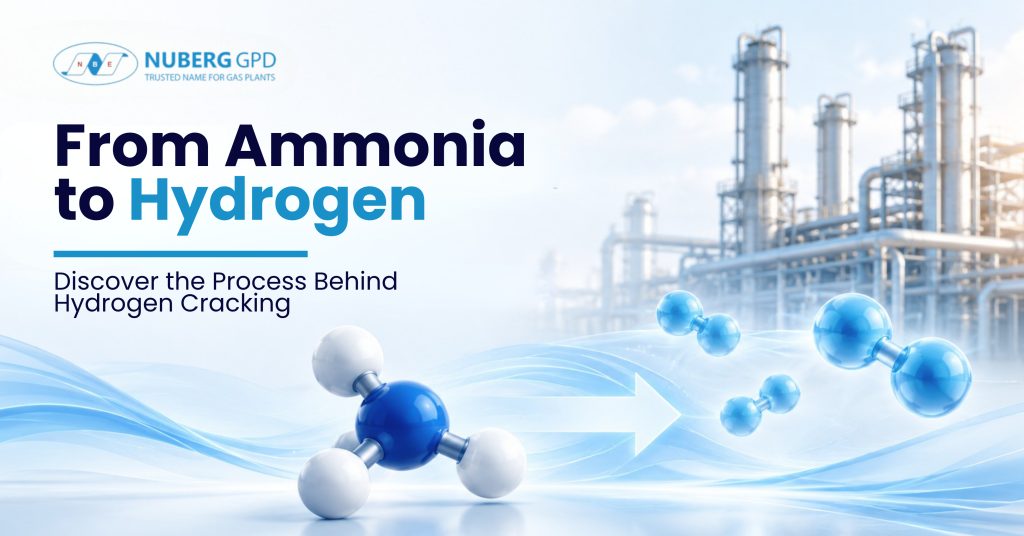
A hydrogen cracker is a unit that splits ammonia into a hydrogen-rich gas, right at the factory that needs it. Bright annealing lines and brazing furnaces use this gas every day.
Pure hydrogen is awkward to buy in. It comes in high-pressure cylinders, and every delivery adds cost.
Ammonia is much easier. It turns liquid at about 8.6 bar at 20 °C, and it is 17.6% hydrogen by weight. So one tank of liquid ammonia carries a lot of hydrogen in a small space.
This guide explains how a hydrogen cracker works and where it fits against other hydrogen sources.
A hydrogen cracker, also called an ammonia cracker or ammonia dissociator, is a type of hydrogen generator. It breaks ammonia (NH₃) into hydrogen and nitrogen.
The output is about 75% hydrogen and 25% nitrogen by volume. Furnace operators call it dissociated ammonia.
That ratio comes straight from the chemistry, so it does not drift from day to day. In our experience, this consistency is the main reason heat treatment plants choose cracked ammonia over mixing gases from separate cylinders.
Main parts of a hydrogen cracker unit
The ammonia cracking process has five steps. The third one does the real work.
Step 1: Ammonia storage and supply
Liquid ammonia sits in cylinders or a bulk tank near the plant. A pressure regulator feeds it to the cracker at a steady rate.
Step 2: Vaporisation
The liquid passes through a vaporiser and becomes gas.
Step 3: Catalytic cracking
The ammonia gas enters a reactor heated to roughly 850 to 1,000 °C. A nickel catalyst inside breaks each molecule apart:
2NH₃ → N₂ + 3H₂
Two molecules of ammonia give one molecule of nitrogen and three of hydrogen. The reaction absorbs heat, so the furnace has to hold its temperature the whole time. If the temperature drops, some ammonia passes through uncracked and ends up in your furnace atmosphere.
We cover the catalyst side in more detail in our post on the role of nickel catalyst in industrial gas processes.
Step 4: Cooling and gas separation
The hot gas runs through a heat exchanger. After that, a dryer strips out moisture and any ammonia that slipped through, which brings the gas down to the dew point the furnace needs.
Step 5: Hydrogen-rich gas output
Clean gas flows to the furnace on demand, at a steady pressure and a fixed 3:1 ratio.
Any process where oxygen would mark or weaken a hot metal surface can use cracked ammonia. The most common uses are:
Metal plants are the biggest users. You can see how we support metal and steel processing industries with on-site gas systems. Auto component makers use the same gas for brazing and heat treatment, which we cover on our automobile industry page.
The main benefit is control. You make the gas yourself, so your supply and your cost stop depending on a delivery truck.
On-site supply you control
No cylinder changeovers. No waiting on trucks. A correctly sized cracker runs 24 hours a day, so furnaces never stop for gas.
Easier storage than pure hydrogen
Liquid ammonia takes far less space than hydrogen stored in cylinders at 150 to 200 bar. Ammonia is toxic and needs proper handling and ventilation. But the storage footprint is much smaller.
Consistent gas quality
Chemistry fixes the ratio at 3:1 hydrogen to nitrogen. Every batch of parts sees the same atmosphere.
Lower running cost
Ammonia is made in huge volumes for the fertiliser industry, so it is easy to source. Per cubic metre of hydrogen, it often costs less than bottled hydrogen, and you also skip cylinder rental and transport charges.
| Method | Feedstock | Output Gas | Best Suited For |
|---|---|---|---|
| Ammonia cracking | Ammonia | About 75% H₂ + 25% N₂ | Heat treatment, brazing, sintering |
| Water electrolysis | Water + electricity | High-purity H₂ | Green hydrogen and high-purity needs |
| Steam methane reforming | Natural gas + steam | H₂ after purification | Large-scale hydrogen demand |
| Methanol reforming | Methanol + water | H₂ after purification | Medium demand without piped natural gas |
| Hydrogen cylinders | Bought-in hydrogen | Pure H₂ | Small or occasional use |
In a heat treatment shop, the furnace atmosphere decides whether parts pass or fail.
A short gas interruption can leave stainless parts discoloured, weaken brazed joints, or scrap a full furnace load. An on-site hydrogen cracker removes that risk. It also cuts truck movements and high-pressure cylinder handling inside the plant, which makes the site safer.
Ammonia is also getting attention as a way to ship hydrogen over long distances.
A hydrogen cracker turns stored ammonia into a steady 75/25 hydrogen and nitrogen gas at your own site. Vaporise, crack over nickel, cool, dry, use.
Nuberg GPD has built industrial gas plants since 1996, and over 30 years of experience goes into every unit we make. Our ammonia cracker plants range from 10 to 300 Nm³/hr at 2 to 10 bar, with a nickel catalyst system built for continuous duty. Fully automatic PLC controls hold the reactor at cracking temperature for seamless operation. Each unit is engineered for maximum energy efficiency, and our comprehensive worldwide service network supports you long after commissioning. You can see the full range under our hydrogen gas plants.
If you are planning a new unit, contact our team with your furnace gas load and we will work out the right capacity.
A hydrogen cracker splits ammonia into hydrogen and nitrogen using heat and a nickel catalyst. It supplies a hydrogen-rich gas for furnaces that need an oxygen-free atmosphere.
Liquid ammonia is first turned into gas. It then passes over a nickel catalyst at roughly 850 to 1,000 °C and breaks into one part nitrogen and three parts hydrogen. The gas is cooled, dried and sent to the process.
Hydrogen generator is the broad term for any system that makes hydrogen, including electrolysis and reforming. A hydrogen cracker is one type that uses ammonia as its feed, and its output is a hydrogen and nitrogen mix rather than pure hydrogen.
Home / What is a hydrogen cracker? Working principle, uses, and benefits A hydrogen cracker is a unit that splits ammonia into a hydrogen-rich gas, right at the factory that needs it. Bright annealing lines and brazing furnaces use this gas
Home / Industrial chemical processes use catalysts as silent motors that initiate and accelerate desired physicochemical reactions. In particular, a nickel catalyst is considered one of the most versatile and cost-effective solutions for gas processing in large-scale production facilities. It is
Home / Nitrogen gas plays a critical role in modern industrial manufacturing and is widely used for inerting, purging, blanketing, and preventing oxidation. Historically, facilities sourced cylinders of high-pressure nitrogen gas delivered on-site. However, with rising cylinder rental costs, gas boil-off
Please fill in your details to download our brochure.