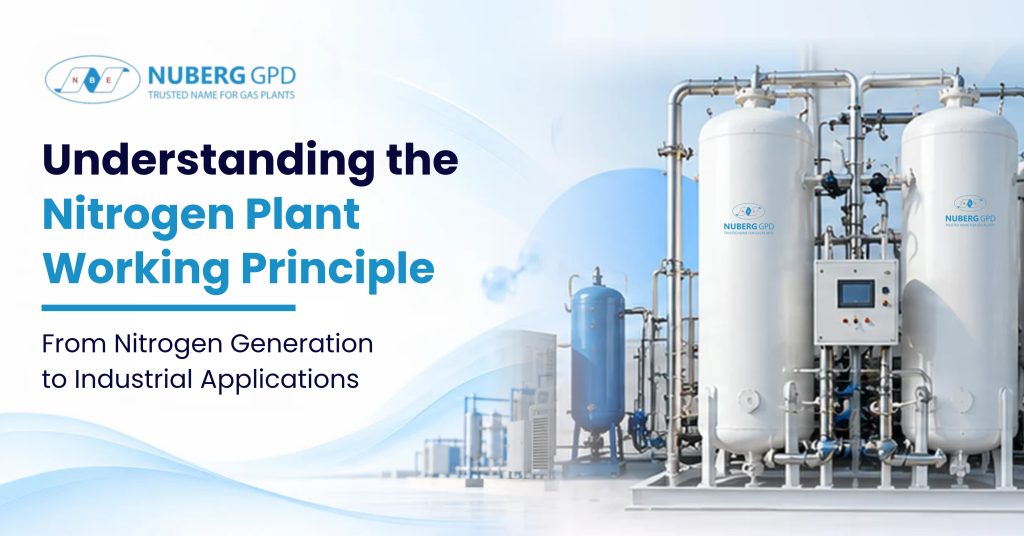
The nitrogen plant working principle is simple at its core. Air already contains about 78% nitrogen, so the plant only has to remove the oxygen, moisture and small traces of other gases. What comes out is a steady supply of dry nitrogen at the purity your process needs.
This guide explains how separation works and walks through the process step by step. It also covers how to size plant capacity and where industries use the gas every day.
A nitrogen plant is a packaged system that turns compressed air into nitrogen gas right where it is used. Most setups share the same core hardware: an air compressor, filters and a dryer to clean the air, a separation unit, a buffer tank to hold the gas and an online analyser that keeps a constant check on purity.
Many factories move away from cylinders and liquid deliveries because transport costs, rental charges and supply delays add up. Producing your own nitrogen gives a predictable running cost and gas on demand.
Every nitrogen plant working principle depends on one fact. Oxygen and nitrogen molecules behave differently, whether the difference lies in molecule size, how fast each gas passes through a membrane, or the temperature at which each one boils.
Compressed air enters a tower filled with carbon molecular sieve (CMS). Oxygen molecules are slightly smaller and get trapped in the sieve pores much faster, so nitrogen flows through. Two towers work in turns. While one produces nitrogen, the other drops its pressure and releases the trapped oxygen. Our guide on pressure swing adsorption nitrogen generation explains this cycle in more detail.
Here, compressed air travels through bundles of thin hollow polymer fibres. Oxygen, water vapour and carbon dioxide pass through the fibre walls quickly and are vented out. Nitrogen continues to the far end and leaves as product gas.
Cryogenic plants cool air to around minus 196°C until it turns liquid. Nitrogen boils at a lower temperature than oxygen, so the two are separated by distillation. You can read more about the science of air separation if you want the full background.
| Method | Typical purity | Capacity range | Best fit |
|---|---|---|---|
| PSA | 95% to 99.999% | 5 to 2,000 Nm³/hr | Most industrial plants needing high purity |
| Membrane | 95% to 99.5% | 1 to 500 Nm³/hr | Low purity, compact or mobile setups |
| Cryogenic | 99.999% and above | 1,000 Nm³/hr and higher | Steel plants, large refineries, liquid nitrogen |
The nitrogen plant process follows the same basic sequence:
In our experience, wet air is the most common reason a PSA plant loses purity early. Step two deserves careful attention at the design stage.
Nitrogen plant capacity is quoted in Nm³/hr, or normal cubic metres per hour. One Nm³ is the volume of gas at 0°C and normal atmospheric pressure, so figures stay comparable across sites.
Purity and flow pull against each other. A PSA plant that delivers 100 Nm³/hr at 99% purity may give less than half that flow at 99.999%, because the sieve has to remove far more oxygen. Once you understand the nitrogen plant working principle, this trade-off makes sense. When sizing a plant, our engineers check:
As a real example, Nuberg supplied a 1,080 Nm³/hr PSA nitrogen plant to UHDE India in Nashik, with one of the tallest PSA towers built anywhere.
Nitrogen is dry and does not react easily, which makes it useful across many sectors. Food packers flush bags and trays with it to keep snacks crisp and extend shelf life. In the pharmaceutical industry, it protects sensitive ingredients from oxidation during reactions, drying and blending. Chemical plants use nitrogen to blanket storage tanks and purge reactors, cutting fire risk. Laser cutting units rely on high-purity nitrogen as an assist gas for clean, oxide-free edges on stainless steel.
Backed by over 30 years of experience, Nuberg GPD delivers high-performance nitrogen gas plants with capacities from 5 to 1100 Nm³/hr. Our systems are equipped with fully automatic PLC controls for seamless operation, engineered for maximum energy efficiency, and supported by our comprehensive worldwide service network. We match the nitrogen plant working principle to your exact purity and flow targets.
Share your flow, purity and pressure needs with our team and we will size the right nitrogen plant for you. Explore our nitrogen gas plants or contact us today.
The plant separates nitrogen from compressed air by removing oxygen and moisture through adsorption, membranes or cryogenic distillation.
Add up peak flow across all use points at the purity you need, then allow a margin for future growth.
PSA suits purity above 99.5% and higher flows. Membrane works well for lower purity and small, mobile setups.
Home / The nitrogen plant working principle is simple at its core. Air already contains about 78% nitrogen, so the plant only has to remove the oxygen, moisture and small traces of other gases. What comes out is a steady supply
Home / It is an industrial unit that makes hydrogen gas on-site from a feedstock such as water, natural gas, methanol or ammonia. Refineries use this hydrogen to remove sulphur from fuels. Float glass lines need it above the tin bath,
Home / Pressure swing adsorption nitrogen generation: how it works and why it matters Pressure swing adsorption nitrogen generation is the standard way to make nitrogen on-site from compressed air. Most factories that use nitrogen every day now make it this
Please fill in your details to download our brochure.